Unboxed
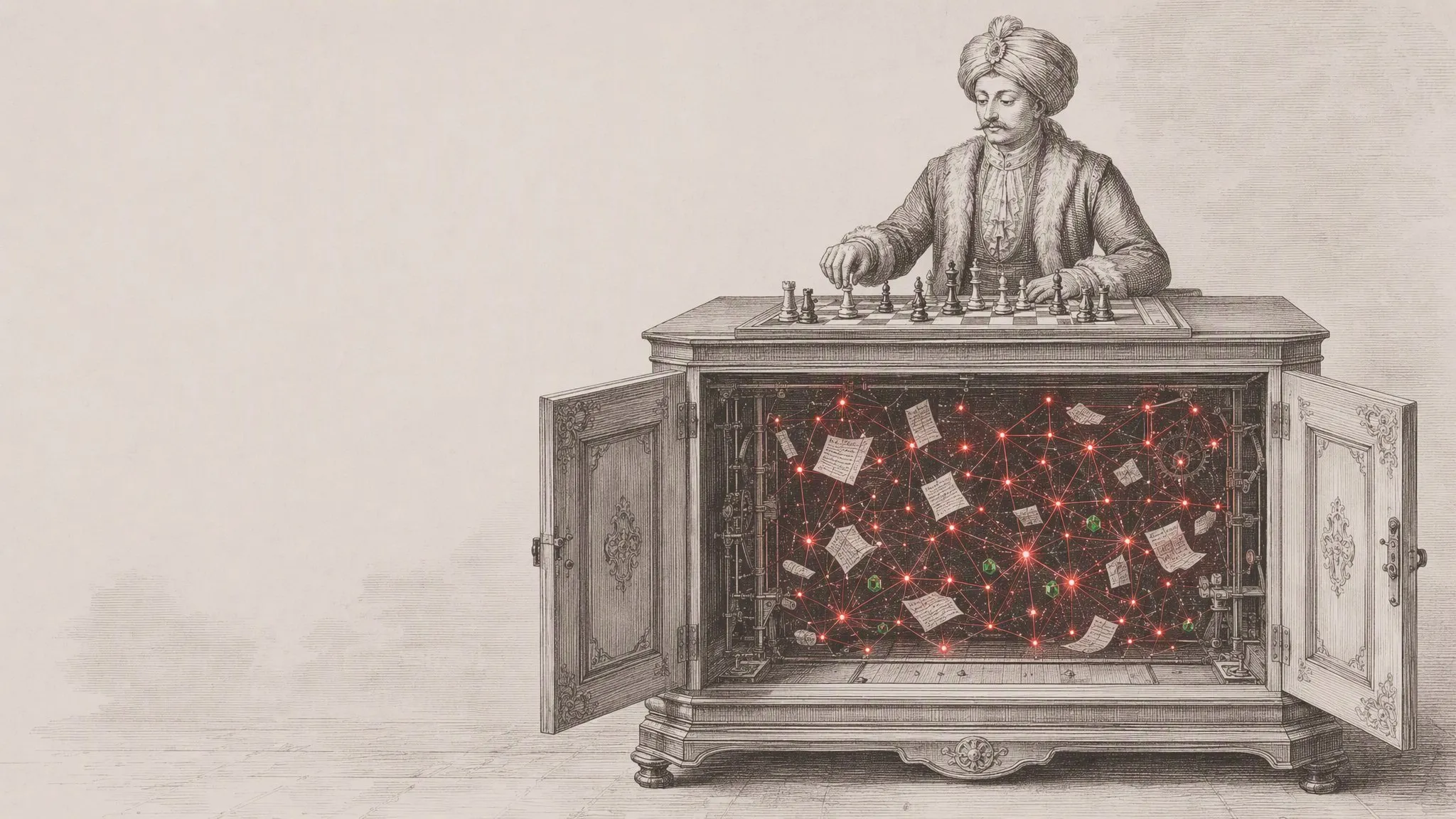
In 1770, Wolfgang von Kempelen presented his chess automaton at the court of Maria Theresa. Before every game he opened the cabinet's doors, one after another, and shone a light inside: nothing but wheels and levers. He never opened them all at once. Inside sat a strong chess player who always slid to wherever a door was closed.
With today's AI, we open all the doors at once.
The chapters
Part 1 · How it works
-
Chapter 1
The map of words
A language model knows no words, only numbers. How those numbers turn into a map you can even do arithmetic on.
-
Chapter 2
The next word
How a language model learns from a simple guessing game that is played an unimaginable number of times.
-
Chapter 3
Word by word
How the guessing game turns into a whole text, and what temperature has to do with it.
-
Chapter 4
Who looks at whom
How real models keep the whole sentence in view. The idea behind the transformer.
Part 2 · What can go wrong
-
Chapter 5
Convincingly wrong
Why AI sometimes makes things up, and sounds so sure while doing it.
-
Chapter 6
What the map takes from us
Why AI can be prejudiced, and where it gets that from.
Part 3 · What it means for us
-
Chapter 7
And us?
What AI is good for, where we humans fit in, and why it pays to think in roles rather than jobs.
Image: generated with GPT Image. Legend has it that a dwarf sat inside the chess automaton. Only a legend: the hidden players were grown-up chess masters.